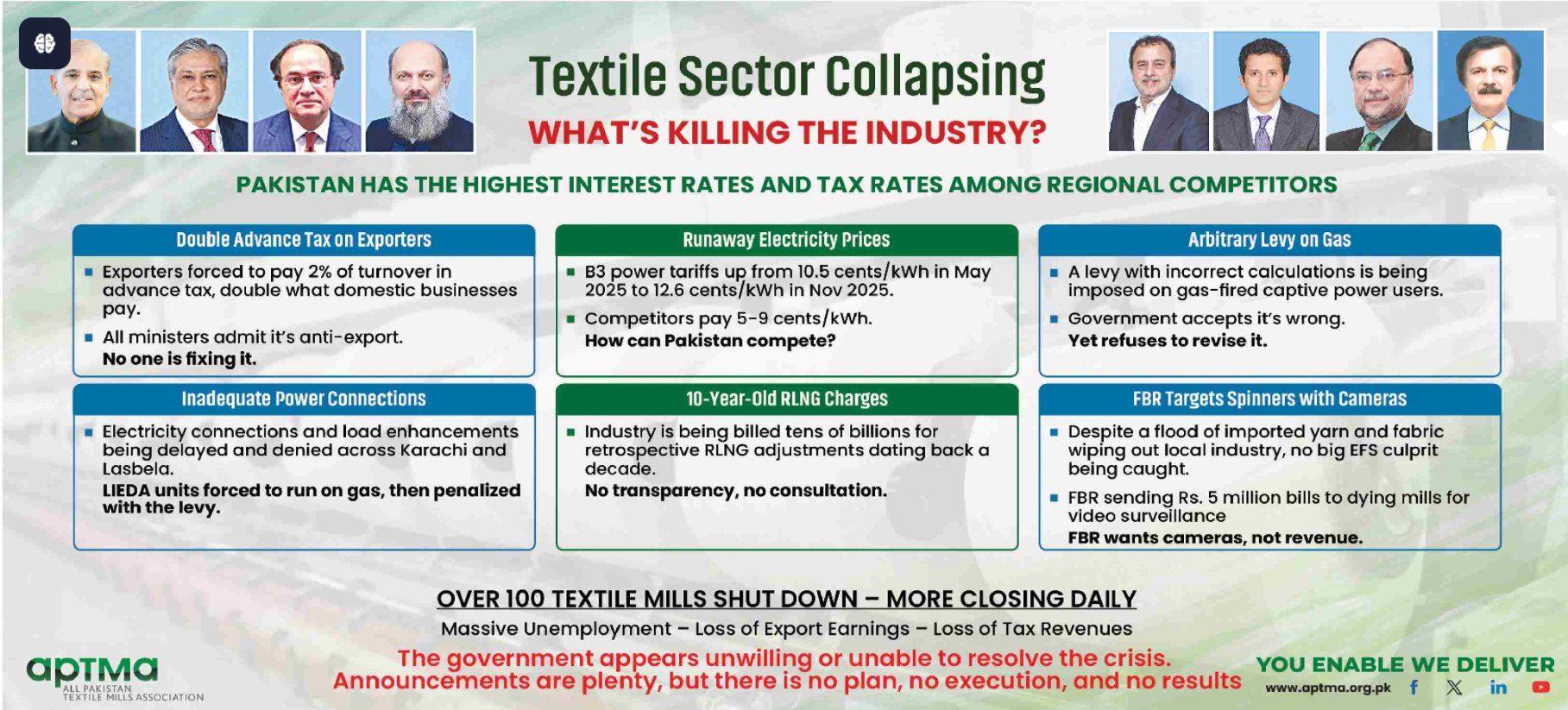
A front-page bottom quarter advertisement by the All Pakistan Textile Mills Association (APTMA), published across major national dailies on Monday, has raised fresh alarms over what the industry terms “a deepening crisis” in the country’s textile sector. In the prominently placed front-page ad, the apex textile body blamed government policies for escalating financial stress on manufacturers, citing the imposition of double advance tax on exporters, soaring electricity tariffs, arbitrary gas levies, inadequate power connections, decade-old RLNG charges, and even surveillance measures targeting spinning units.
Painting a bleak portrait of the economic fallout, APTMA warned that more than 100 textile mills have already shut down, with others on the brink, triggering widespread job losses, shrinking export earnings and diminishing tax revenues.
While listing numerous problems and portraying a picture of chaos, the ad fails to mention the substantial perks the textile industry has enjoyed in recent years, nor does it acknowledge how the sector repeatedly missed export targets despite receiving generous incentives and benefiting from GSP Plus status that allowed duty-free access to European Union markets.
Textile Sector: History of Incentives Without Results
Pakistan’s textile and garment sector has long been seen as the backbone of the country’s industrial base. It is often described as the largest employer and the biggest contributor to exports. But beneath this narrative lies a hard truth. For decades, the sector has benefited from incentives that few other industries in Pakistan have ever enjoyed. Successive governments have offered zero-rated tax holidays, low-interest loans, subsidised energy, and generous bank financing under programmes meant to modernise mills and upgrade machinery. These policies were introduced with the belief that supporting the textile sector would boost exports and strengthen Pakistan’s economy. Yet the results have been disappointing.
The sector’s leadership, especially the All Pakistan Textile Mills Association (APTMA), has made it a habit to criticise government decisions and market conditions. Every few months, industry spokespeople appear in the media blaming high input costs, energy shortages, or currency fluctuations for their losses. While these factors do affect production, the complaints create an impression that the government is always at fault. But this narrative ignores the larger reality. Pakistan’s textile sector remains the most privileged segment of industry, yet it continues to struggle with competitiveness and export growth. Many other countries, operating with fewer subsidies and tougher conditions, have managed to grow their textile exports far more rapidly.
According to the State Bank of Pakistan’s first-half yearly report (H1-FY26) the textile sector remained Pakistan’s largest industrial exporter and showed a modest recovery in the first half of the fiscal year (July to December 2024), supported by better raw material availability, lower borrowing costs, and improved apparel exports. However, the report highlighted that the sector continues to rely heavily on government incentives, including subsidised energy, export-orientated credit schemes, and favourable financing facilities such as large increases in working-capital loans, which rose by Rs 503 billion in H1-FY25.
Despite being the biggest recipient of industrial subsidies, the textile sector underperforms in productivity and innovation, often using incentives to sustain existing operations rather than investing in R&D or value addition
A closer look at the past two decades shows how the industry has often failed to use the support it received. Instead of reinvesting profits to modernise equipment, improve efficiency, or develop new products with higher value addition, many mill owners preferred short-term gains. There was little focus on innovation. Upgrading technology was slow. Training workers and improving management practices did not receive the attention they deserved. As a result, productivity remained low, and Pakistani textiles struggled to compete in the global market, where quality, precision, and timely delivery determine success.
While enjoying unmatched advantages at home, several major players quietly began shifting operations abroad. Many textile businesses expanded into Bangladesh and the UAE, where they found better industrial environments and more predictable policies. But their move had an unexpected impact. Bangladesh’s textile and garment exports rose dramatically. The very factories and expertise that once belonged to Pakistan began powering another country’s success. Bangladesh invested in worker training, modern machinery, and efficient supply chains. The results spoke for themselves. Within a few years, Bangladesh became one of the world’s largest garment exporters, while Pakistan continued to lag behind.
Despite this shift, many Pakistani industrialists still blame domestic conditions for their failure to grow. The same groups that flourished in Bangladesh claim that policies in Pakistan are hostile or inadequate. They point to high energy tariffs or rising cotton prices, but they seldom mention their own reluctance to innovate or reinvest. Their criticism hides the fact that other sectors within Pakistan, even with fewer incentives, have shown resilience and growth potential. The textile sector, however, continues to depend on subsidies and special treatment.
High Cost of Avoiding Reform
Every few years the same alarm is raised. Industry leaders warn that the “textile sector is collapsing.” They demand more relief, more subsidies, and more government intervention. The message is always the same. Without immediate financial support, the industry will fail. But collapse does not occur suddenly. It takes years of avoiding reform, delaying investment, and relying on government protection. When an industry chooses shortcuts over long-term planning, the damage becomes inevitable. It is not external forces alone but internal decisions that create decline.
If the textile sector is struggling today, much of the responsibility falls on the industry itself. The decades of preferential treatment created a culture of dependency. Instead of fostering innovation, it encouraged complacency. Instead of encouraging competition, it reinforced old habits of rent-seeking. Instead of strengthening the export base, it weakened the drive for excellence and efficiency. Countries that were once far behind Pakistan in textile capacity have now surpassed it because they invested in their people, their technology, and their management systems.
Pakistan’s textile leaders often argue that they need a “level playing field”. But a level playing field does not mean endless subsidies. It means improving quality, increasing efficiency, and building industries that can survive without constant government support. It means focusing on value-added products instead of relying on low-end yarn or unfinished cloth. It means diversifying markets and improving branding. It means adopting sustainable and modern production methods that global buyers now demand.
The time for theatrics and blame games is over. Pakistan can no longer afford an industrial sector that refuses to take responsibility for its own shortcomings. The country needs industries that perform, compete, and innovate. The textile sector must understand that the global market is unforgiving. It rewards countries that upgrade and punishes those that rely on excuses. If the sector hopes to survive and grow, it must accept that the old ways no longer work.
A sustainable and competitive textile industry is possible. Pakistan has a young workforce, access to cotton, and a strategic geographic location. But none of these advantages matter unless the industry reforms itself. Genuine change requires investment in modern machinery, skilled labour, efficient management, and responsible leadership. It requires transparency and accountability. It requires a willingness to look inward instead of blaming others.
Pakistan deserves better than an industry that perpetually complains. It deserves one that rises to the challenge and becomes a source of national pride. The future of the textile sector depends on its ability to adapt, innovate, and compete. The opportunity is there. The question is whether the industry is willing to take it.