
Shujauddin Qureshi
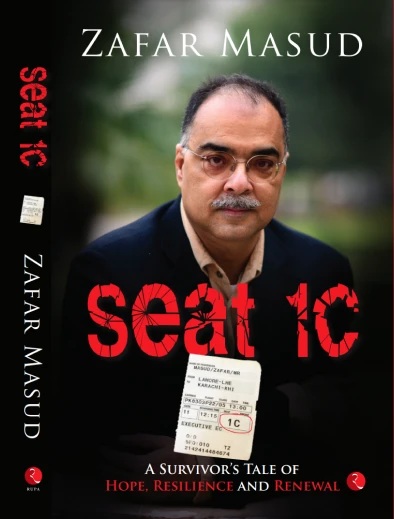
In the PIA air crash on May 22, 2020 there were only two survivors. One of them was Zafar Masud, the CEO of Bank of Punjab, who wrote a book ‘Seat 1C’ after five years of the crash sharing his experiences before and after the crash.
He has also shared some of experiences of the other survivor Zubair, who managed to come out of the burning aircraft when he found a split space and he used that gap to climb on a wing to finally land on rooftop of a house in Karachi’s Model Colony.
But Zafar’s story is quite interesting as he lost his senses just after the crash as he says he remembered for only 30 seconds after the plane hit the earth first time. In fact the plane hit the earth many times before final crash and setting ablaze, he writes in his book.
Zafar Masud, the only son of famous film and TV artist Munawar Saeed. A graduate of Institute of Business Administration (IBA), Karachi and single so far has served many national and international business entities before joining BoP as President and CEO on April 16, 2020.
The book covers various themes and the author has linked those themes with various aspects around the crash and international references. For example, in “Arrogance” he explains in details the arrogant attitude of the pilot and control tower officials of Karachi airport.
He says the pilot changed the landing runway on his own ignoring the control towers suggestion. Moreover, he pointed out that the staff at the control tower left their chairs to offer Juma prayers as it was the last Friday of Holy month of Ramazan. He also discussed the overall arrogant attitude in Pakistani society and also gave international references.
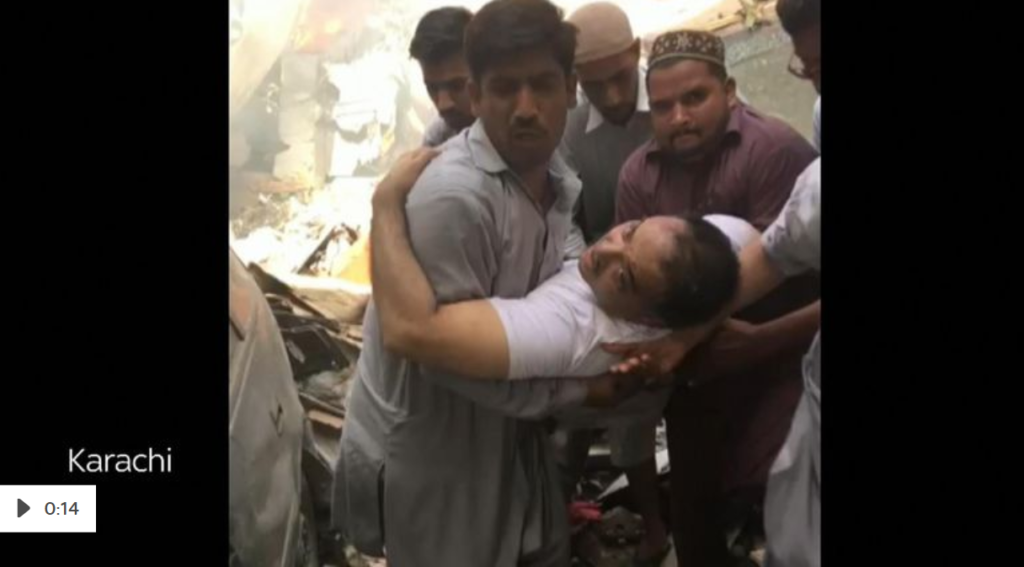
Similarly, he adds a chapter with a title “Goodness”, which keep track of the human attitude of common people and charity work being performed by various individuals and institutions.
During the crash how local people acted upon to rescue him, Zubair and other dead till the official rescue teams arrived and cordoned off the area. As the airplane was crashed at rooftops of homes and narrow streets, it was very difficult to reach the burning wreckages of the airplane.
Because Zubair was conscious during the final crash, he quotes the struggle he performed to come out from the burning hull of the aircraft and reaching at a rescue ambulance. Zubair’s narrative was interesting. Zubair landed at rooftop of a house and found the way to reach at a street. He remembers walking up to a vegetable seller’s cart and asking for water.
The seller had been busy hawking his produce when the plane crashed. With everyone’s attention now riveted to the crash site, he was irritated by Zubair’s request, but complied anyway.
Seat 1C, full of inspirational stories
But Zafar Masud’s rescue was unbelievably miraculous. He writes: According to eyewitnesses, my seat fell straight on to a third-floor rooftop of the road. The angle of the fall reduced the damage to my body. The seat then slid off the rooftop and on to the bonnet of a car, instead of landing on the hard asphalt of the road below, further breaking my fall. By then, the plane had crashed into the other end of the street.
The most interesting chapter for me was “Dues” in which he describes his Near Death Experience (NDE) before becoming unconscious after the crash. His 30 second NDE experience was almost the same as other NDE survivors have been describing in earlier researches and their narratives.
Those 30 seconds were quite important in his life, as he went through the NDE, a profound psychological event reported by people who come close to death or are clinically dead for a short time, often involving sensations such as leaving the body, moving through a tunnel, seeing bright light, or feeling peace.
He explained those experiences in details in “Dues” chapter. The other survivor, Zubair, of course, was not able to go through NDE because he remained awake during his evacuation effort.
As a curious reader, I had read more about NDE by many past authors, who had explained almost the same experiences especially the feeling of absolute peace despite what as presumed tragic deaths. One of my friends in Karachi Asif Ali Azad had once shared such an NDE when was about to die drowning, but he was rescued anyway.
The detailed and inspiring experience, shared by a Hongkong based Sindhi lady Anita Moorjani, who has explained the NED in his book “Dying to Be Me: My Journey from Cancer, to Near Death, to True Healing” and a series of YouTube videos made by her. A cancer patient on death bed in a hospital in Hongkong, she was almost dead when she was told to go back as her time has not come.
Zafar Masud writes that before going unconscious, he heard his inner voice that he would survive the crash. “I can say it was every bit as profound as those before me have described, if not quite as dramatic.
There was an unflappable calmness—a steadiness that pervaded all my thoughts and my being. I contemplated the plane crashing and saw the panic around me, but it was not mirrored within me. It was not exactly a numbing of my thoughts; I did not feel disembodied or removed from the situation, but my thoughts were not frenzied or fearful. In fact, they had the penetrative clarity that many survivors speak about. At the time, I had not read about NDEs, so I could not place my feelings within an existing body of anecdotal data. I just knew what was about to happen and that it was going to be all right.”
He then gives examples of NDE researches made in the world especially by geologist Albert Heim, who experienced NDE in 1871 in Switzerland. In February 1892, Heim presented his collection of other survivors’ account at the Swiss Alpine Club in Zurich.
But was not aware about Anita Moorjani and her NDE narratives. After his talk at Adab Festival 2025 in Karachi, I asked him about his point of view about NDE he briefly described that he experiences it before going unconscious. He writes in the book:
“One thing that leapt out at me, in addition to all the commonalities identified by researchers before me, was how obligations seemed to fight their way to the forefront of the survivor’s mind—even when they were wrestling with much more consequential thoughts. Heim had been concerned about a lecture he had promised to give. A century and a half later, another plane crash survivor, Ric Elias, spoke about how his last thoughts were of his wife and family, and his will to eliminate negative energy from his life.”
Tahir Masud emphasizes to fulfill all your obligations to other people as there is no time of death. You need not to regret of completing your responsibilities.
“It is telling of the human condition that so many survivors—separated by decades and experiences—all recalled their obligations to other people, whether trivial or weighty. This was more indicative of my experience than the rosy clouds and orchestral music that some have described.”