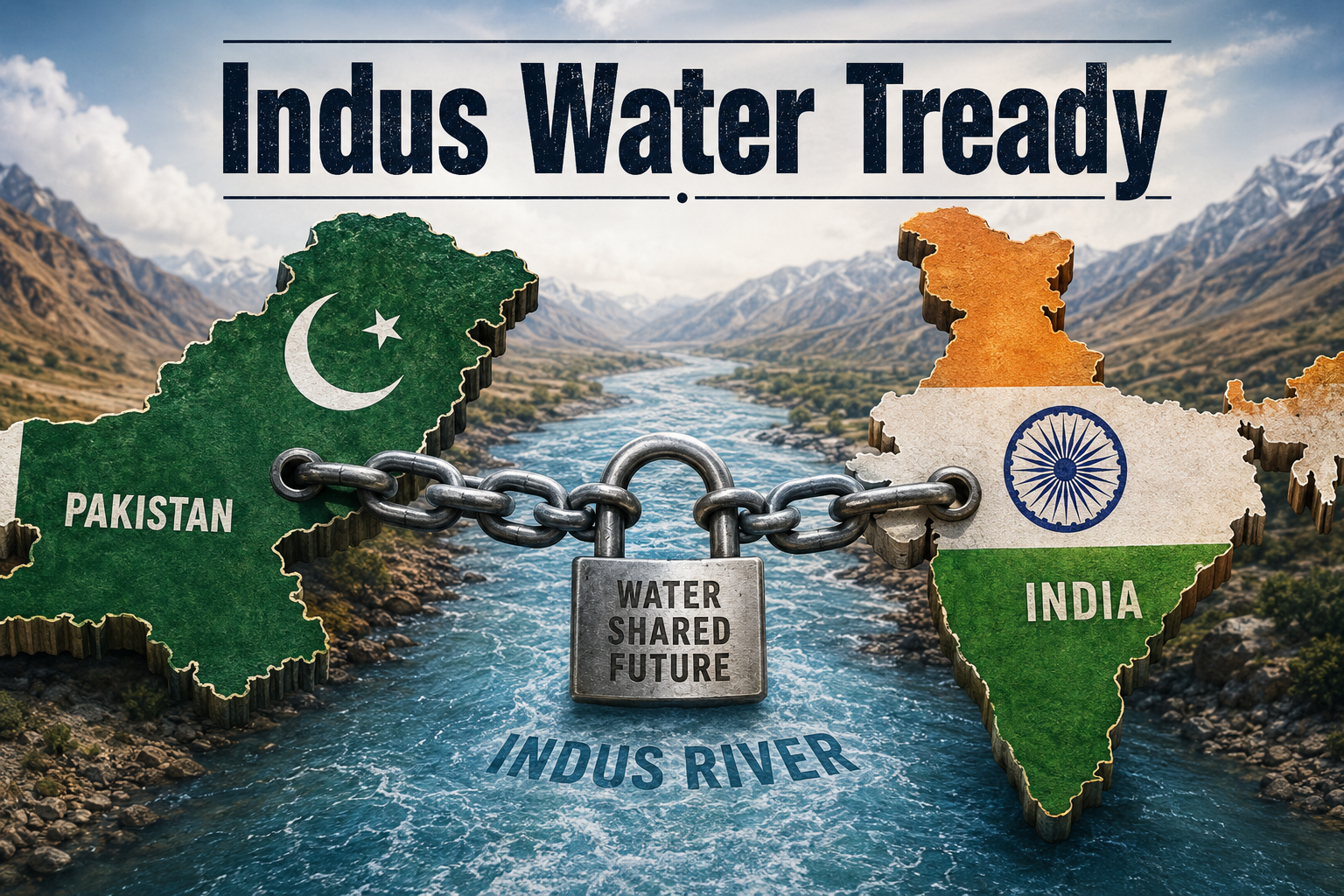
Indus Treaty Verdict: The Permanent Court of Arbitration in The Hague has delivered a historic and significant ruling on one of the most sensitive disputes between Pakistan and India, declaring that the 1960 Indus Waters Treaty remains fully in force and that India cannot unilaterally suspend or terminate its obligations under the agreement.
The ruling comes at a time of exceptionally strained relations between the two nuclear-armed neighbours, making the decision important not only from a legal perspective but also for the future of water security in South Asia.
The court has also imposed temporary restrictions on certain construction activities at India’s Ratle hydropower project on the Chenab River in Indian-administered Kashmir.
International wire service Reuters reported that the count asked India “must uphold a water-sharing treaty with Pakistan” and must restrict work on a hydroelectric project in the Kashmir region. The Reuters report noted that the treaty guarantees water supplies to around 80 per cent of Pakistani farms and has remained in place since 1960 despite three wars and numerous other conflicts between the two countries.
The ruling directly challenges India’s decision in April 2025 to place the Indus Waters Treaty in what New Delhi described as “abeyance”.
India took that step following a so-called terrorists attack in Pahalgam in Indian-held Kashmir in which 26 people were killed.
India accused Pakistani nationals or elements of involvement in the attack, an allegation Islamabad rejected. Relations deteriorated sharply afterwards, eventually leading to a brief military confrontation between the two countries in May 2025.
On May 7, 2025, India carried out its first major military strikes inside Pakistan after the Pahalgam attack, roughly 15 days later. India said it struck nine sites that it described as terrorist infrastructure in Pakistan and Pakistan-administered Kashmir.
One of the principal targets was Markaz Taiba in Muridke, Punjab, which India described as the headquarters of Lashkar-e-Taiba. Reuters reported that India claimed the facility was linked to banned LeT.
Pakistan’s account differed significantly. Islamabad said the Indian strikes hit six locations and that they were not militant camps. Reuters reported that Pakistan initially said eight people were killed in the first strikes.
After a brief head-on, both the countries came to ceasefire. US President Trump claimed he played a key role in ceasefire between two nuclear powers of South Asia.
After the ceasefire, India announced to unilaterally cancel Indus Water Treaty. Pakistan, however, brushed aside the possibility of cancellation of this international treaty. Pakistan, in a tit-for-tat, announced that it would place the 1972 Simla Agreement in abeyance, reciprocating India’s decision concerning the Indus Waters Treaty and disallow Indian airlines to fly over Pakistani skies.
Indus Water Treaty: Lifeline for Pakistanis
For Pakistan, the dispute is about much more than a diplomatic disagreement. The Indus river system is at the heart of the country’s agricultural economy, food production and rural livelihoods.
The treaty gives Pakistan rights over the waters of three main western rivers: Indus, Jhelum and Chenab. While the eastern rivers, Ravi, Beas and Sutlej, were allocated primarily for India’s use. The agreement also established mechanisms for the exchange of water-related data and the resolution of disputes between the two countries.
The importance of the agreement is difficult to overstate. Pakistan is a predominantly irrigated agricultural country, and a very large share of its cultivated land depends on water flowing through the Indus Basin.
According to the material cited in the original report, the Indus system provides water to approximately 80 per cent of Pakistan’s agricultural land. Any major disruption to the treaty could therefore have consequences extending far beyond irrigation, potentially affecting food security, rural incomes, energy production and the wider economy.
The 1960 treaty is also notable for its resilience. It survived wars, military crises, diplomatic breakdowns and decades of political hostility.
For more than six decades, it provided a framework within which the two countries could manage their shared river system even when their broader relationship was deeply troubled.
That history makes India’s 2025 decision particularly significant. By announcing that the treaty would be kept in abeyance, New Delhi introduced a fundamentally different dimension into the dispute.
Pakistan argued that the treaty did not contain any provision allowing either country to suspend it unilaterally. The Hague court has now broadly supported that legal position.
Indus Treaty Verdict and India’s Rejection of Court’s Authority
The Permanent Court of Arbitration examined several arguments put forward by India to justify its decision. These included allegations concerning Pakistan’s conduct, cross-border terrorism, demographic changes, India’s growing clean-energy requirements, advances in dam technology and the effects of climate change.
The court concluded that none of these considerations provided a sufficient legal basis under international law for India to unilaterally suspend or terminate the treaty.
The court also rejected India’s argument that Pakistan had failed to cooperate in the spirit of the agreement or had refused to negotiate changes to the treaty.
According to the ruling, Pakistan was not under a legal obligation to negotiate changes simply because India wanted the agreement revised. The court further rejected the argument that cross-border terrorism could provide grounds for suspending the treaty, noting that the treaty governs water rights and obligations rather than issues relating to terrorism or the use of force.
This is arguably one of the most consequential aspects of the decision. The court’s position is that the treaty cannot simply be placed on hold because relations between the two countries have deteriorated. If either country wants to modify or terminate the agreement, the treaty’s own legal framework and the principle of mutual consent remain relevant.
Reuters reported that the court specifically stated that the treaty “remained fully in force”, adding that India had no justification for ending or suspending it. The court also said India must comply with its obligations concerning the design and operation of hydroelectric projects on the Western Rivers.
Yet the legal ruling has not produced political acceptance in New Delhi. India has categorically rejected the decision, arguing that the arbitration court has no authority to rule on India’s sovereign decisions. India’s Ministry of External Affairs said New Delhi does not recognise the court’s jurisdiction in this matter and that its pronouncements would have no effect on India’s actions relating to its hydropower projects.
This creates an important distinction between the legal significance of the ruling and its immediate practical consequences.
For Pakistan, the verdict strengthens the argument that India’s unilateral suspension of the treaty has no legal basis.
For India, however, the rejection of the court’s jurisdiction means that New Delhi does not appear prepared to change its position simply because of the ruling.
The dispute over hydropower projects adds another layer to the controversy. Pakistan has repeatedly raised concerns about Indian projects on the Western Rivers, particularly where reservoir capacity, water storage and the design of dams could affect the timing or volume of water flows downstream.
The Ratle Hydroelectric Project on the Chenab River has become a particularly important case. In response to a Pakistani request, the court ordered India not to raise the dam wall and power-intake structure above specified levels until 90 days after the World Bank-appointed neutral expert issues a final decision on the project’s compliance with the treaty.
Reuters reported that the neutral expert is expected to determine by July 2027 whether the hydropower projects in the Himalayan region comply with the Indus Waters Treaty.
The court also imposed reporting requirements concerning the construction schedule for Ratle, although it did not grant two other interim measures requested by Pakistan.
The Ratle decision is important because it demonstrates that the dispute is not merely about the abstract legal status of the treaty. It is also about how the treaty applies to modern hydropower development.
India has argued that its energy needs, technological developments and clean-energy transition require greater flexibility in developing projects on rivers covered by the agreement. Pakistan, meanwhile, fears that changes in dam design and storage capacity could affect downstream water availability.
Climate change makes this debate even more complicated. The Indus Basin is already under pressure from changing precipitation patterns, rising temperatures, glacier dynamics, population growth and increasing demand for water.
Both countries face growing water challenges, but their competing interests make cooperation increasingly difficult.
The Hague decision therefore comes at a critical moment. It does not resolve the broader India-Pakistan relationship, nor does it automatically end the dispute over hydropower projects.
India’s rejection of the ruling means that political and diplomatic tensions are likely to continue. Nevertheless, the decision provides an important legal reference point by affirming that the Indus Waters Treaty remains in force.
Pakistan has welcomed the verdict, saying it supports its longstanding position that India remains bound by its treaty obligations.
Islamabad has also welcomed the restrictions imposed on the Ratle project and indicated that it will examine the decision in detail to determine how it could help revive communication and negotiations under the treaty.
The bigger question now is whether the ruling can become an opportunity for renewed dialogue rather than another source of confrontation. Water is ultimately a shared resource, and the rivers of the Indus Basin do not recognise political borders.
A legal dispute can establish rights and obligations, but long-term water security requires functioning institutions, transparency, data sharing and communication between the two countries.
The Indus Waters Treaty was created precisely because India and Pakistan understood that their shared rivers required rules even when political relations were hostile. Its survival for more than six decades is evidence that water cooperation is possible despite deep disagreements.
The latest Indus Treaty Verdict may, therefore, prove important beyond the immediate legal dispute. It reinforces the principle that international agreements cannot simply be suspended at the will of one party and highlights the importance of established mechanisms for managing transboundary water resources.
For Pakistan, the ruling offers a measure of legal reassurance at a time when concerns over water security are growing. For India, it presents a challenge to its decision to place the treaty in abeyance and to its broader approach to hydropower development on the Western Rivers.
But the ultimate test will come after the headlines fade. If both countries use the ruling as a basis for returning to structured dialogue, exchanging information and addressing technical disagreements through established mechanisms, the crisis could eventually become an opportunity to strengthen the treaty. If, instead, the legal decision becomes another battlefield in the already bitter India-Pakistan relationship, the risks will extend far beyond diplomacy.
For millions of farmers, communities and households across the Indus Basin, the issue is not simply about treaties, courts or sovereignty. It is about water, livelihoods and survival. That is why the future of the Indus Waters Treaty matters not only to India and Pakistan, but to the wider future of South Asia.